
We need more. We're getting less.

We need more. We're getting less.
Max Woolf here,
If you don't want to spend more than $600 on a ticket to this year's World Cup, but don’t want to watch alone at home either, we’ve created a directory of restaurants and bars across our communities that will be showing matches throughout the tournament.
Games begin Sat. June 13.
| Where to watch the World Cup |
If you operate a local restaurant, bar or hotel and want to add your business, complete this form.
Massachusetts needs more immigrants. Fewer are arriving
One-quarter of Massachusetts workers were born outside the U.S.
That’s according to a new report from Boston Indicators and the MassINC Policy Center, which puts numbers behind something we already know: immigrants are indispensable to the Massachusetts economy.
The report found that they sustain every sector of the economy, from research laboratories and universities to hospitals, construction sites, restaurants, senior and child care, and Main Street small businesses.
Immigrant workers also help offset two powerful demographic trends in Massachusetts: an aging population and the continued loss of residents to other states.
Researchers estimate Massachusetts will need at least 60,000 net new immigrants annually by 2030 just to maintain its current working-age population. Without immigration at a scale close to that, the study warns, the Commonwealth risks economic contraction.
Yet federal policy is pushing in the opposite direction. Roughly 40,000 immigrants arrived in Massachusetts last year. The report estimates that the number could fall below 30,000 this year.
Can those workers afford to live here?
The report also found that most immigrants are settling in Gateway Cities and other relatively affordable areas of the state.
That should give our communities pause.
Few places in Massachusetts are feeling the effects of an aging population and the loss of younger residents more acutely than our own. Yet many of the workers Massachusetts now depends on would struggle to afford a home here.
If we want to do more than just say we welcome immigrants, we need to build communities where immigrants can actually afford to live.
Here’s something else we’re short on: Candidates
Across our Charles River Regional Chamber footprint, there are three state senators and nine state representatives whose job it is to represent our communities on Beacon Hill
But this November, only two of those eleven lawmakers will face a competitor on election day.
In the 10th Middlesex District, which includes Watertown and Nonantum, incumbent State Representative John Lawn will face Newton City Councilor Alison Leary, a rematch of the 2020 race, which Lawn won by 431 votes.
Meanwhile, in the Suffolk and Middlesex Senate District, which covers all of Watertown and Belmont, as well as parts of Cambridge and Boston, Senator William Brownsberger will face challenger Daniel Lander, a former aide to Boston Mayor Michelle Wu, who so far is quietly backing Lander.
That's it.
The remaining nine legislators representing our communities are effectively guaranteed another term. While Massachusetts is no stranger to uncontested elections, our region is doing even worse than the state as a whole. Statewide, roughly three out of five legislative races will go uncontested this year.
Here, it's more than four out of five.
And while some or all may very well deserve another term, our system works best when voters have a choice.
Competition fosters debate, holds elected officials accountable and creates opportunities for new ideas and new leaders to emerge. And Beacon Hill could use more of all of those things. After all, Massachusetts's legislature was recently ranked dead last in the nation for efficiency.
Babson’s new executive lodge reaches new heights
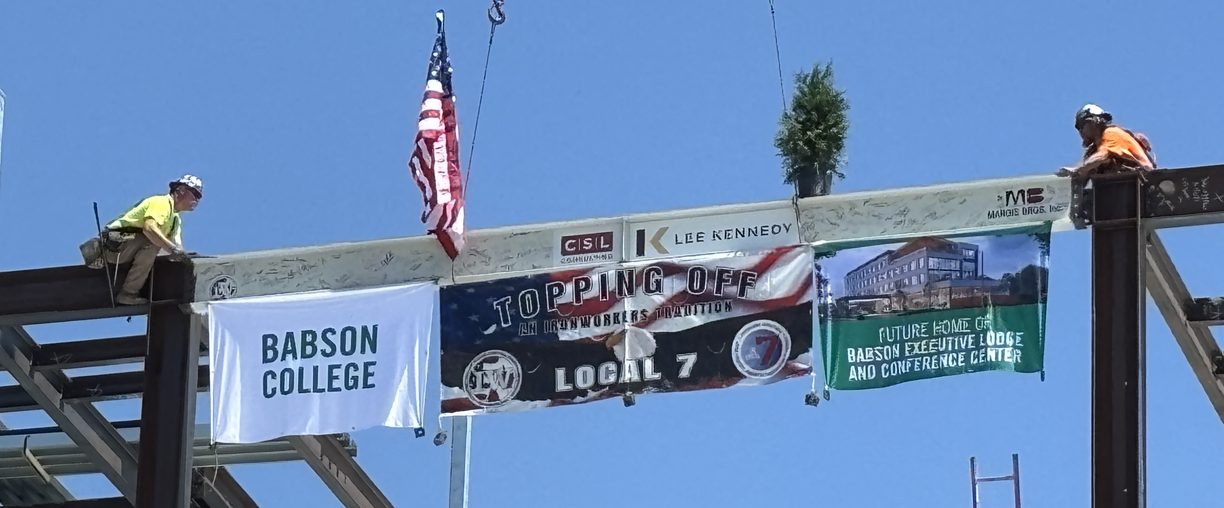
Just days after announcing his resignation next June, Babson College President Stephen Spinelli Jr. oversaw the topping off of the school’s new Executive Lodge and Conference Center on Thursday.
Then Spinelli challenged his team and Lee Kennedy Company to have the building open in time for his retirement party.
The 77,600 SF facility will include 70-plus modern guest rooms, 8,900 SF of classroom and executive event space, a large banquet hall for corporate and community events, a full-service restaurant and bar, a rooftop terrace and a dedicated fitness area.
Friday grab bag
- The proponents of the controversial ballot question that would cap rents statewide are floating a compromise they say would keep rent control off the ballot. The proposal, already backed by several prominent developers, is significantly less restrictive than the ballot question and would leave the decision to adopt rent control in the hands of local communities. Let us know what you think
- There are nine spots left for our second annual Women’s Conference, taking place next Friday at Lassel University. Get your tickets ASAP it's too late.
- Needham’s Select Board unanimously voted this week to ban home deliveries of recreational cannabis. Not sure what that solves since residents can just drive to one of these places. (Needham Observer)
- The Wellesley Planning Board narrowly endorsed East Longmeadow Planning Director Robert Watchilla to be the town’s next planning director. In a 3-2 split vote, and after much spirited debate, the board has advanced his application. The job has been open since the former director, Eric Abrneee, left late last year.
- The New York Times recently highlighted chamber member and Watertown-based Life Admin Navigator and founder Tulsi Vadodaria in a story on the growing field of daily money management. The article explored how professionals like Vadodaria help individuals navigate financial and administrative challenges during transitional periods in their lives.
- Babson's Graduate Experiential Learning Program is offering business consulting services from its MBA students at no cost. Applications are due by June 15 for projects that kick off in September.
- Watertown News has a great profile of High Tech Turning, a family-owned manufacturer that has spent more than four decades producing precision components for medical devices.
Boston Ballet Executive Director Ming Min Hui will step down this fall after 11 years with the organization, including the past three as executive director. Hui helped guide the ballet, which has a location in Newton, through the pandemic and a period of sustained growth. (Globe) - Secretary of Transportation and MBTA General Manager Phil Eng will be happy to hear that Beacon Hill has agreed to direct nearly $800 million in millionaire's tax revenue toward transportation, the largest share since voters approved the surtax. (Banker and Trademan)
Farmers’ market comes to Newton Centre
Newton will test a new approach to energizing village centers next Saturday (June 13) when Union Street in Newton Center is transformed into a one-day farmers' market.
The event will feature more than 25 vendors and involve closing off Union Street to vehicle traffic all morning.
Spearheaded by the Laredo administration's economic development team, the market is part of a broader effort to increase foot traffic and support small businesses. It will also serve as a pilot for a possible weekly market next summer.
The ultimate measure of success, however, won't be attendance alone, but whether the event drives meaningful sales and exposure for Newton Centre businesses. We also hope the city minimizes disruptions from the street closure and makes it easy for nearby businesses to participate and benefit.
A familiar face takes the stage
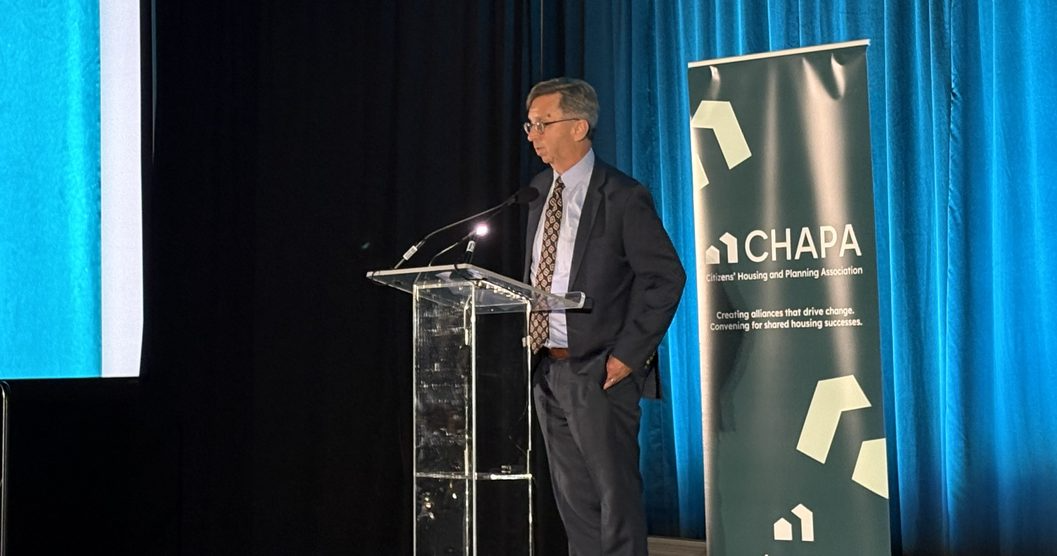 |
More than one thousand housing advocates from across the state gathered in Boston last night for the 59th annual dinner of the Citizens’ Housing and Planning Association (CHAPA), one of the state's leading housing advocacy organizations.
And you might recognize one, or even two, of the evening’s honorees.
Chamber President Greg Reibman received CHAPA’s Community Engagement Award, using his acceptance speech to remind a room full of statewide housing leaders not to overlook the local battles.
“The fights are always going to be in our town and city halls,” Reibman said, as he gave a shoutout to every local housing advocacy group in the chamber’s five communities and urged others to do the same.
Also honored were Whitney Demetrius, the state’s Director of Fair Housing, and Wellesley public housing advocate and resident Renee Spencer.
Spencer shared her journey from eviction and homelessness to becoming one of Massachusetts’ leading tenant advocates. Today, she serves on both the Wellesley Housing Authority Board and the Mass Union of Public Housing Tenants board.
Congratulations to all three honorees.
That’s what you need to know for today, unless anyone saw the northern lights last night. (If you missed it, you still have a chance tonight.)
Public Policy and Government Affairs Manager
Charles River Regional Chamber
617-431-6101
I also value your feedback